
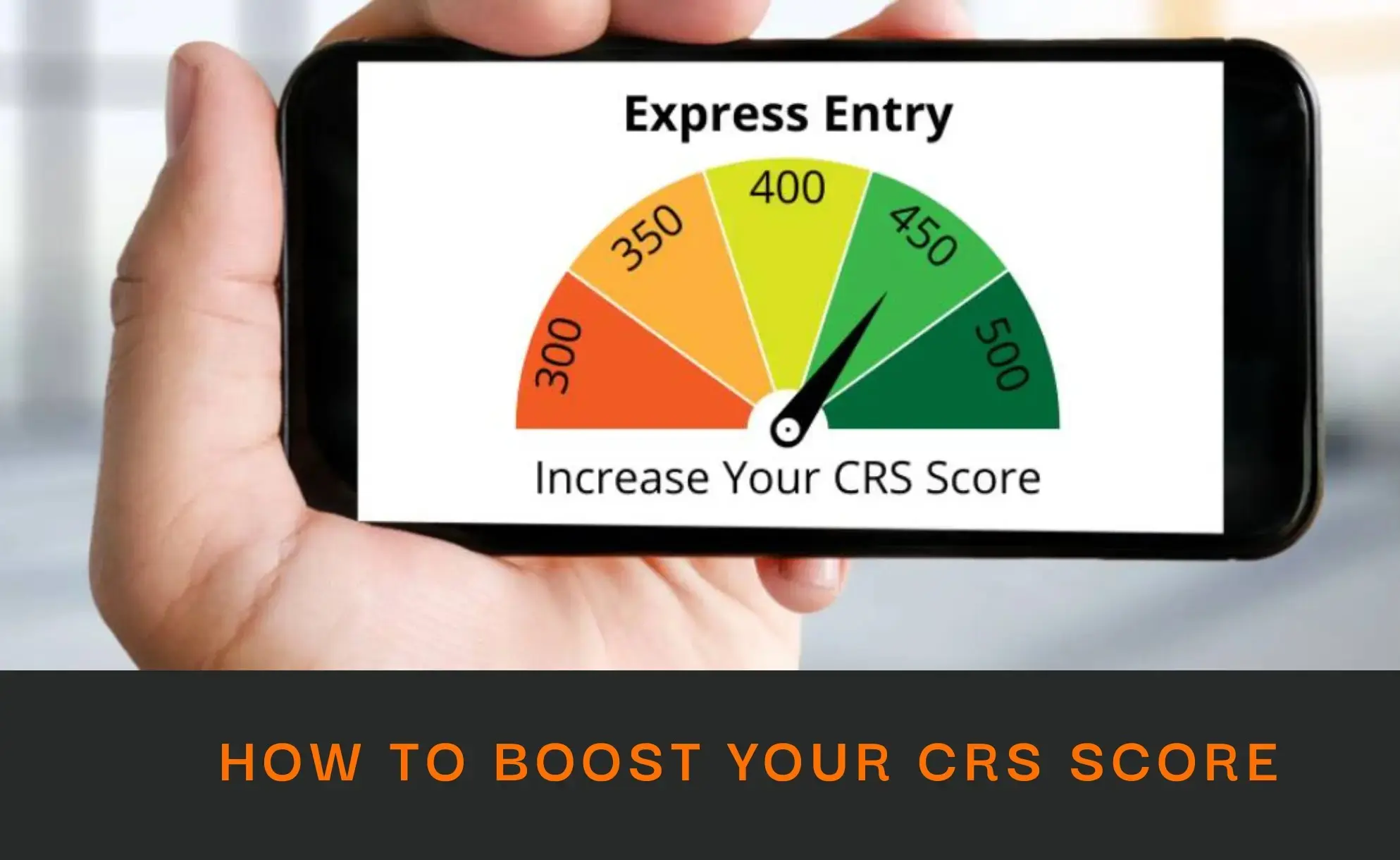
One of the most popular and efficient ways of entry through immigration to become a skilled worker in Canada is the Express Employment system of Canada. The core of this system is the Comprehensive Ranking System (CRS) which is a system of points that identifies (depending on the scores), whether an applicant can receive an Invitation to Apply (ITA) to get permanent residency.
In order to get more chances of achieving success, you have to know how CRS works and what strategies should be applied to improve the score. In this blog we are going to discuss all the possible means through which you can boost your CRS score and get a kick-start towards boosting your Express Entry profile.
What is the score of CRS?
CRS score refers to the number of points (1,200) that helps to rank the candidates amongst the Express Entry pool. The arguments are identified in four major headings:
Key Factors of Human Capital (qualification, language skills, working experience, age)
Factors Common-law Partner/Spouse
Transferability of Skills Factors
The Additional Factors also include a job offer, provincial nomination, Canadian education/work experience, siblings in Canada, etc.
1. Become a Better Speech giver
One of the most weighted activities in the CRS is language skills. Rebecca is the first language is English / French:
A second language: 24 points
Repeat your IELTS, CELPIP or TEF test and achieve the score of at least CLB 9.
The extra points which were marked against skill transfer people are the bilingual capability.
The language improvement can be done as follows:
They have also worked much in a communication-friendly environment.
It is advisable to have a test in English and French to have extra points.
A high increase in the language score can as well lead to high increment in your CRS even though there may be multiplier effect in other areas.
2. Good Job Experience
One of the most important things in the CRS is the work experience. The candidate has an opportunity to add more points through the following ways:
Gaining another experience in some skilled work experience in home country.
Coming to Canada to obtain a work experience that is given higher recognition under the CRS.
Submitting an application under Canadian Experience Class (CEC) provided that it is eligible as per Canadian conditions, one year after working in Canada.
Make sure that you have occupational titles classified in the CRS as NOC TEER 0, 1, 2 or 3 in order to qualify as jobs.
3. Need to have a higher education
Educational qualifications count up to 150 points in the CRS although more points may be earned through combining skills transferability.
Acquiring a master’s degree or doctorate of philosophy.
The process of receiving Canadian educational qualifications, in the event that you study in Canada.
Having your international qualification valued: This should be done through an ECA (Educational Credential checking).
College education is not just another equation that tallies point but is also able to show its collective strengths with other CRS factors also.
4. Provincial Nomination (600 Points!)
A PNP nomination is among the fastest means to increase your CRS score by 600 points, which is an all-but-guarantee of an ITA.
The process of learning how to get a PNP:
Through an express program which is sent directly to one of the province specific streams that confirms the Express Entry.
Apply to the Express Entry and show interest in a province.
Ride on the pull to the provinces and match your profile with the needs of labour market.
Some of the most popular provinces with active PNPs are those of Ontario, British Columbia, Alberta, Saskatchewan and Nova Scotia.
5. Get a Legitimate Job Position
Although a PNP is superior, a valid job offer sponsored with an LMIA (Labour Market Impact Assessment) can give 50 to 200 CRS points depending on the kind of occupation.
50 points: NOC TEER 0, 1, 2, or 3
200 points: Leader occupations (NOC 00)
A good way of getting a job offer is networking, job boards such as Job Bank, and Canadian employer contacts.
6. The related factors concerning the Spouse
When you apply with a spouse or common-law partner, the qualifications of your spouse or common law partner would have the capability of enhancing your overall CRS score.
ECA-Required Degree in Exams in language is scored.
Education (ECA required).
Work experience in Canada.
It is also possible to opt to apply as principal applicant when your spouse has a better profile.
7. Incorporate Siblings in Canada
You have an additional 15 CRS points when you or your spouse has a brother or sister who lives as a permanent resident or citizen in Canada. It is important that you write this relationship down in your application.
8. Preliminary creation of Express Entry Profiles
Aspects like age are considered of great importance because the highest scoring (cases up to 110) are assigned to individuals between ages 20 and 29. Points are then dropped on a gradual basis.
Therefore make sure that you do not take too long to apply. When you are getting 30 or older, it is time to look at how you can compensate the aging negative scores by scoring better on other factors.
Final Thoughts
Improving your CRS score is not a case of fixtures and fastenings—there is a strategy to the activity and preparation and persistence are important factors. All these steps are important, whether you need to retake your language tests, go back to school, get a job offer, or a PNP.
As Canada plans to take in more Immigrants than ever before with over 400K in one year it is the right moment to invest in your Express entry profile. When in need, consult the professional and keep abreast of the draw trends and immigration developments. The higher the CRS score, the likelier you are to obtain an ITA, but it also makes you go through an accelerated process of making a new life in the most accepting country of the world.